
BY RABBI MOSHE BILLER
Pass the giraffe meat please.
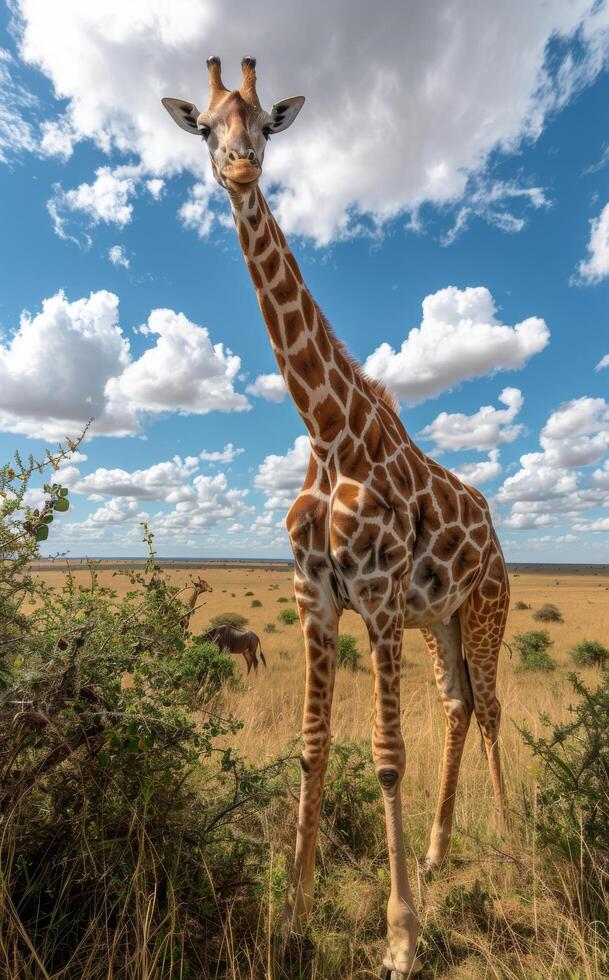
Is it possible that a kosher meat-board might someday feature meat from a giraffe? There has been much discussion about the kashrus of the giraffe. Some of the questions this article will address include whether a giraffe is, in fact, a kosher animal; the proper location to perform shechita along its long neck; and whether it is categorized as a חיה (non-domesticated animal), whose חלב (forbidden fats) are actually permitted, or as a בהמה (domesticated animal), whose חלב is forbidden.
The Torah lists seven kosher non-domesticated animals – חיות – and within the list is the זמר.¹ Rabbeinu Saadya Gaon identifies this animal as the זראפ”ה,² which was understood by scholars as a well-known animal whose skin is spotted, whose arms are longer than its legs, whose neck is elongated and whose horns are short.³ Rav Dovid Kimche in his Sefer Shoroshim, in the name of Rabbeinu Yonah, translates the זמר into Arabic as זוראפ”ה.⁴ The Tashbet”z calls the זמר an אלזראפ”ה whose neck is long and whose body is huge such that she can be standing inside the “wall” while her head is sticking up outside the “wall”.⁵ From these descriptions of the זמר we can easily theorize that the identity of this animal is the giraffe and that it is a kosher animal.⁶
That said, there is an early opinion which calls this theory into question. The Ibn Ezra⁷ says that although we know the identity of two of the חיות mentioned in the Torah; the איל, a gazelle, and צבי, a deer; the identity of the other five, including the זמר, are unknown to us. To consume one of the other five animals, we would need to have a broad consensus, from shochtim and rabbonim, identifying the animal as one that was shechted and consumed by Jewish communities. Since there is no such consensus, we would have to assume that the giraffe is not a kosher animal. This is also the opinion of the Chezkuni.⁸
However, even if we cannot identify the זמר as the giraffe with absolute certainty, perhaps we can still consider it a kosher animal. After all, it is the biggest ruminant that has split hooves.⁹ Rabbi Amitai Ben David, author of Sichos Chullin, suggests that the חיה called the keresh described in the Gemara Chullin as a wild deer with a single horn and which is sixteen amos (cubits) long¹⁰ and is kosher,¹¹ is the giraffe.¹² Rabbi Ben David explains in a beautiful piece that while the giraffe has two ossicones¹³ on its head, the third smaller bump protruding from its forehead is the single “horn” in the Gemara’s description of the keresh.¹⁴ This theory is substantiated by the suggestion that is found in the Yerushalmi Shabbos¹⁵ that the keresh is the same animal as the tachash mentioned in the Torah regarding covering of the Mishkan. The tachash, too, is described as having a single horn aside from two others which protrude from its head.¹⁶ The various characteristics that we find regarding both the keresh and tachash are strikingly apparent in the giraffe.¹⁷ The keresh is described as a gigantic animal.¹⁸ The Gemara in Bava Basra describes the horn of the keresh as ugly and blackening in colour.¹⁹ The tachash is beautified by its many patterns.²⁰ Indeed, Sefer Divrei Yehosef (Shvartz) testified that in the year 5614 they brought several giraffes to Eretz Yisroel through Egypt and that he inspected them and determined that they contain all the signs that are required in a kosher animal.²¹
Some believe that giraffes are not consumed because we do not know the correct place on their long neck to perform shechita. However, this is far from the truth.
There is a common misconception about the kashrus of giraffes that needs to be dispelled. Some believe that giraffes are not consumed because we do not know the correct place on their long neck to perform shechita. However, this is far from the truth, as it is clearly stated in the Gemara and Shulchan Aruch that the entire neck is kosher for shechita.²²
If the giraffe contains all the signs of a kosher חיה²³ and the entire neck is kosher for shechita then what is the reason we do not shecht and consume giraffes? Perhaps it is because there is no “mesorah” – tradition – to shecht them. When it comes to birds, the Torah does not list simanai kashrus. Instead, there is a long list of non-kosher birds while all other birds are kosher. Since we are not sure of the identity of all the non-kosher birds listed in the Torah, we require a mesorah to consider a bird kosher.²⁴ However, when it comes to an animal, the requirement of mesorah on top of the simanai kashrus is the subject of a dispute, and the custom amongst the communities of Lita was to be stringent according to their Posek, the Chaye Odom.²⁵ However, other European communities did not require a specific tradition as long as the animal contained simanai kashrus.²⁶ It would be sensible to say that American communities whose roots are from those communities have the right to be lenient.²⁷ While it is true that there is no tradition to shecht the giraffe, this may be because it was not available to Jewish communities in Europe and elsewhere throughout the generations.
So why do we not shecht and consume the giraffe? The answer may be as simple as the fact that they are not bred in America and are not economical. If we were to try to shecht them it is likely that giraffe meat would be too costly to offer to the masses. Furthermore, since they did not shecht giraffe throughout the generations and there is no tradition, we would not be able to apply the leniency of the חיה to the giraffe and the consumption of its חלב would be forbidden.²⁸ In addition, we would have to act stringently and perform כיסוי הדם which is a requirement for kosher birds and חיות. ∎
RABBI MOSHE BILLER
Rav Hamachshir Shechita
Kashruth Council of Canada | www.cor.ca — 2025-5785 Passover Guide, pp. 58–59
COR, the Kashruth Council of Canada, is one of the world’s largest kosher certification agencies, certifying thousands of products, restaurants, and facilities. Learn more at cor.ca, or read about our certification services at corkosher.com.