
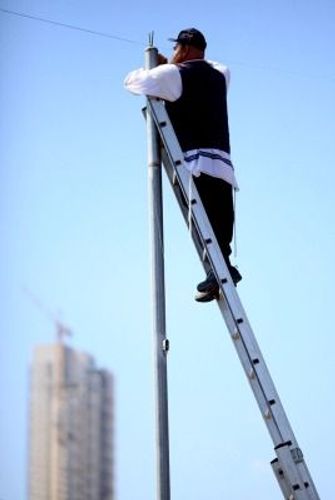
Myths & Facts
BY: RABBI YOSEF DOVID ROTHBART
Designing, checking and maintaining eruvin at cottages, camps and the like are some of the many halachic services that the Halacha Institute of Toronto (H.I.T.) offers the community. Through our experience, we have encountered several common misconceptions which can result in accidental transgressions of the melacha of carrying on Shabbos. In the following article we will outline eight such misconceptions.
MYTH #1
My yard is private property and therefore I don’t need an eruv in order to carry within it on Shabbos.
FACT: A reshus hayachid in which a person is allowed to carry is not defined by ownership. Rather, it is an area – even publicly owned – that is surrounded by valid partitions.¹ A private yard that does not have valid partitions is a karmelis² and it is not permitted to carry within it on Shabbos.³
MYTH #2
A tzuras hapesach can be made using a string wrapped around the top portion of each of the two poles.
FACT: A tzuras hapesach resembles a doorframe consisting of two poles (doorjambs) and a crossbeam or string⁴ (door head) on top.⁵ Therefore, just as a doorway, the crossbeam must lay directly on top of the poles and be supported by them.⁶ If the string is wrapped around the top portion of the pole the resulting crossbeam may come off the side of the pole in a way which is pasul.
MYTH #3
The crossbeam (string) of the tzuras hapesach does not have a minimum height requirement.
FACT: A tzuras hapesach has a minimum height requirement of ten tefachim.⁷
We have seen this to be an issue when a tzuras hapesach spans a hill or elevated ground. At times there are areas in which the string of the tzuras hapesach is within ten tefachim of the ground, thereby invalidating the tzuras hapesach.
MYTH #4
A bunkhouse can always be used as a wall for tzuras hapesach when it is elevated from the ground.
FACT: A mechitza is a partition that begins within three tefachim (lavud)⁸ of the ground,⁹ rises ten tefachim¹⁰ and is strong enough to withstand typical winds.¹¹ Therefore, a building which is elevated and its walls start higher than three tefachim above the ground does not constitute a mechitza.¹²
We have seen many bunkhouses that while in some areas their outer wall reaches within three tefachim of the ground, in other areas it does not. Therefore, if someone is using the outer wall of a bunkhouse as a mechitza, the entire wall should be checked. If most of the wall is within lavud while a minority portion is not, the wall can still be a kosher mechitzah by applying the principle of omed meruba¹³ which allows us to validate the entire mechitza including its gaps, since the gaps are not void as we are the solid section.
If the bottom of the building begins at ten tefachim of the ground, there is a discussion whether the tzuras hapesach should be considered a tzuras hapesach.¹⁵ One should consult with a rav for guidance.
MYTH #5
A tzuras hapesach in a wooded area is easier to construct than in an open area.
FACT: Building an eruv in an open area has its challenges; there are no trees onto which to attach the lechis. On the other hand, building an eruv in an area full of trees is not without its own obstacles. Although the availability of trees gives many options for attaching lechis, the branches oftentimes move the string which must be on top and in between the lechis. A string that is deflected from in between the two lechis causes the tzuras hapesach to become invalid according to many Poskim.¹⁶ One must either cut the branches that deflect the string (and check constantly that they did not grow back) or use very wide lechis so that the string will always remain in between them.
MYTH #6
Bushes are a proper mechitza since one cannot walk through them.
FACT: A mechitza does not have to be a fence or a man-made partition. Thick trees such as evergreens or bushes that run along a property can constitute a mechitza. However, one must check to ensure that greenery is not too sparse at the bottom, or this will invalidate the mechitza.
If some sections are dense at the ground while other sections are not (and there is a three tefachim gap from the dense branches to the ground), then only the dense sections are considered valid mechitzos, unless omed meruba can be applied (See Myth #4). If the bushes (or a fence) have several gaps of varying sizes, with some of them wider than the solid sections next to them, it is questionable whether omed meruba can be applied, and a halachic authority should be consulted.¹⁷
MYTH #7
Once my eruv is constructed, I only need to check the strings to make sure that they have not fallen, not the fences.
FACT: Besides checking to see if the strings are all intact, it is necessary to check that branches did not grow and deflect them. As well, it is important to check the fences that used to create the eruv to make sure that they are still within three tefachim of the ground and ten tefachim high. Over time, the terrain changes and some fences curl up and may no longer serve as a valid mechitza. Experience has shown that this happens especially in cottage country where the ground is softer. Finally, it is necessary to check the poles from time to time to ensure that they have not broken or rotted, and that brush and greenery has not enveloped the poles in a such a way that they are no longer visible.¹⁸
MYTH #8
I now have enough information to build my own eruv.
FACT: This is an introduction to some of the common misconceptions that we at H.I.T. have noticed. There are many halachos involved in building an eruv and each eruv is unique, presenting its own challenges. To ensure that your eruv is kosher, you should have it reviewed by someone who has experience in constructing eruvin, since a single oversight might invalidate an entire eruv. ∎
Rabbi Rothbart is H.I.T.’s Rabbinic Administrator
UNDER THE LEADERSHIP OF THE RABBONIM OF H.I.T.
Rabbi Yacov Felder, Chairman
[email protected] | 416.535.8008 | www.halachainstitute.com
Halacha Line • Rabbinic Mediation • Pikuach Nefesh Issues • Halachic Estate Consulting • Halachic Business Consulting
Kashruth Council of Canada | www.cor.ca — 2021 / 5782, Halachic Corner, pp. 10–11
COR, the Kashruth Council of Canada, is one of the world’s largest kosher certification agencies, certifying thousands of products, restaurants, and facilities. Learn more at cor.ca, or read about our certification services at corkosher.com.