
Can Peeled Onions, Garlic, and Eggs Be Left Overnight?
BY: RABBI YECHIEL TEICHMAN
The danger:
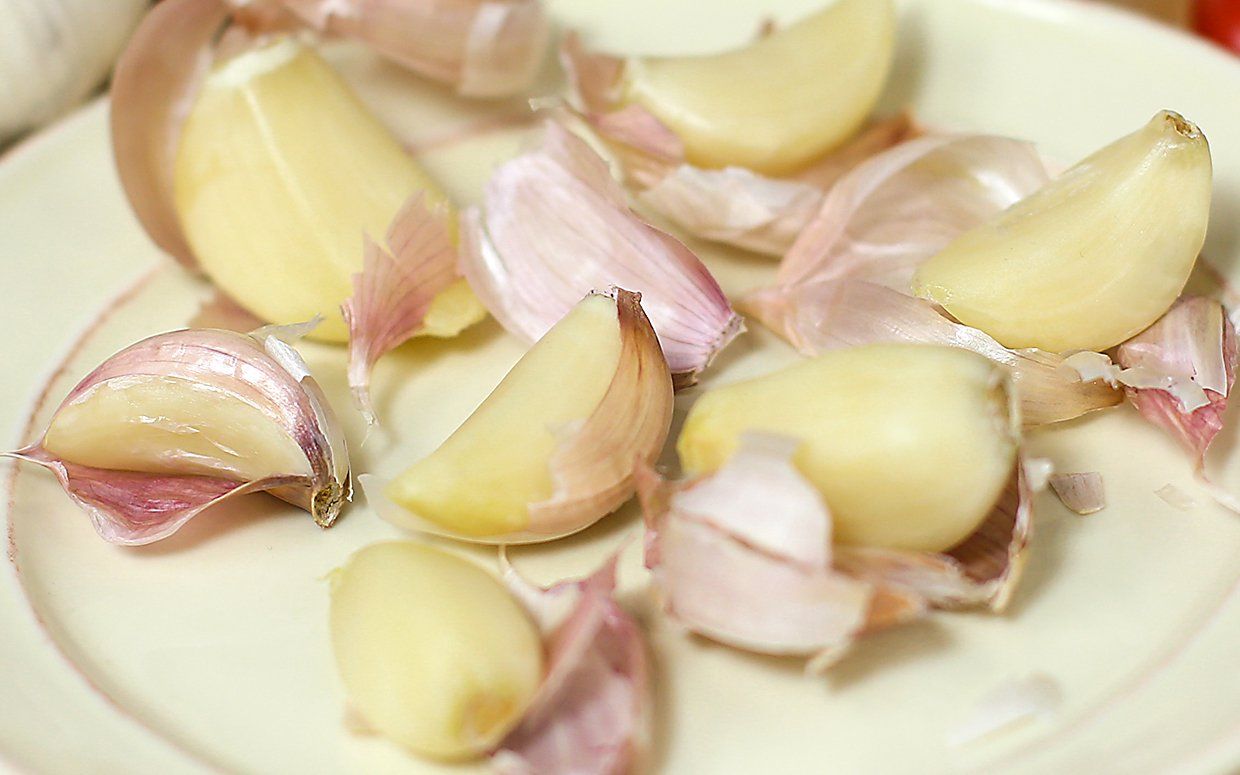
The Gemara (Nida 17a) in a statement by Rabbi Shimon bar Yochai says that one who eats peeled onions, eggs, or garlic that were left overnight, is endangering his life. In fact, the person will be held responsible, as if he took his own life.¹ The reason for this is that a ruach ra’ah, a type of spiritual contamination, rests upon these three foods when peeled and left overnight. Many follow this custom and are very careful to not leave peeled eggs, onions, and garlic overnight unless steps are taken to eliminate the danger of ruach ra’ah.
Exceptions:
The above mentioned Gemara states that if parts of the original peel or root hairs remain on the onions, eggs, or garlic then they are not considered peeled, and there is therefore no danger.² Another solution mentioned in the poskim is to mix in another ingredient so that the peeled food item is then considered part of a mixture.³
Does this apply today?
There seems to be a contradiction between two Tosafos about whether this halacha applies today. In Masechtes Beitza (14a) the Gemara states that one may grind spices on Yom Tov in the normal manner, only if preparing it before Yom Tov is not a viable option. Tosafos writes that one may crush garlic on Yom Tov in the normal manner because it won’t stay fresh. Tosafos then adds that it is also because one cannot prepare it earlier, as it would then be susceptible to ruach ra’ah as stated in Gemara Nida. Clearly Tosafos believes that ruach ra’ah is still relevant today.
On the other hand, the Gemara in Yoma (77b) states that although washing for pleasure is forbidden on Yom Kippur, one may wash one’s hands before feeding a child, as this is necessary to prevent shivsa, a type of ruach ra’ah. Tosafos explains that besides washing negel vasser upon awakening in the morning, one must wash again prior to feeding a child to prevent this ruach ra’ah. Tosafos then wonders why we no longer have the custom to wash before feeding a child. Tosafos answers that shivsa is not prevalent in our areas and therefore this custom is no longer relevant.
There are different approaches of how to reconcile these two seemingly contradictory Tosafos. In Divrei Yatziv (Y.D. 1:31) the Klausenberger Rebbe states that there is a distinction between different types of ruach ra’ah. While some may be extinct, other types may still exist. This is clear since Tosafos in Yoma still requires one to wash negel vasser upon awakening and only states that the additional washing before feeding a child is no longer relevant. Similarly, Tosafos in Beitza teaches that the ruach ra’ah associated with peeled onions, garlic, and eggs left overnight is still a concern.
Another approach is to treat all ruach ra’ah as one category and when Tosafos states in Yoma that ruach ra’ah is not prevalent this applies to all ruach ra’ah. But if this is the case, how do we then reconcile the two contradictory Tosafos? In Shevet Halevi (3:169) Rav Shmuel Vozner states that there is a difference between l’chatchila and b’dieved.⁴ Although ruach ra’ah is no longer prevalent, it is not totally extinct and therefore one should preferably not leave peeled garlic overnight. Since it is preferable not to prepare the garlic before Yom Tov, that is enough of a reason to permit crushing it on Yom Tov in the normal manner. Rav Vozner therefore concludes that since ruach ra’ah is not prevalent, one can be lenient and permit leaving peeled onions overnight in combination with another mitigating factor such as first drying the onions in an oven.
Commercial production:
Many produce companies offer pre-peeled onions and garlic that are packaged for future use. Sometimes the produce is frozen and used many months later. There are also commercially produced eggs that are cracked and frozen to be used at a future date. When producing specifically for a kosher brand, the hechsher will generally require some salt to be added to the eggs, onions, or garlic before they are left overnight. Brands that are marketed to the general public will generally have no additives. If so, can a kashrus agency certify these products?
In Igros Moshe (Y.D. 3:20) Rav Moshe Feinstein states that it is permissible to certify these products even though they were pre-peeled. The Gemara Nida is discussing the regular situation, of one who peels garlic, eggs, or onions for imminent use, and then changed his mind or forgot to eat them. If these are left overnight they are susceptible to ruach ra’ah. However, if one is intentionally preparing the peeled items to be used many days later, this is not the same case that the Gemara is discussing, and is therefore permitted. The major national hashgachos, including COR, rely on this ruling of Rav Moshe Feinstein when certifying commercially produced peeled eggs, onions, and garlic.
A common scenario that arises is when a bakery or caterer prepared onions or eggs the day before to be used the next morning. Rav Moshe Feinstein was asked whether this would qualify for his above mentioned leniency. He answered that this Tosafos in Beitza that it is not permitted, as Tosafos says that one can prepare the garlic on Yom Tov, since he cannot do it before Yom Tov. Tosafos offers two reasons why he cannot prepare it before Yom Tov. The first reason is that is does not taste as good when prepared the day before, and the second is that it will be susceptible to ruach ra’ah. We see from here that when it is prepared to be used the next day it is susceptible to ruach ra’ah.
Due to this, when an establishment prepares peeled onions or eggs, COR policy is that salt must be added if they will be left overnight.
Rav Moshe Feinstein further analyzes the Tosafos. Why is the first reason offered by Tosafos that the garlic will not taste as good? Wouldn’t the reason of ruach ra’ah be more of a definitive and compelling reason? After all, one might be able to maintain the taste of the prepared garlic by storing it in a manner that preserves the taste, while ruach ra’ah cannot be prevented by storing it in a sealed jar.⁵ Rav Moshe therefore learns that first Tosafos entertained that perhaps ruach ra’ah does not apply when one intentionally prepared for the next day, so Tosafos says it will lose its taste if prepared before Yom Tov. Then Tosafos concludes that preparing for the next day is also subject to ruach ra’ah. This, says Rav Moshe Feinstein, can help prove his point. When eggs, onions, or garlic are peeled for use many days later it is permitted, since Tosafos only went so far in the second reason to forbid leaving over when prepared for the next day.
Be safe:
Since there are differing opinions as to the status of ruach ra’ah,⁶ if it applies today,⁷ and to what extent,⁸ one should consult with their rav to determine which custom to follow. ∎
Rabbi Teichman is a Rabbinic Administrator and Halachic Advisor at COR
Kashruth Council of Canada | www.cor.ca — 2020 / 5781, Halachic Corner, pp. 8–9
COR, the Kashruth Council of Canada, is one of the world’s largest kosher certification agencies, certifying thousands of products, restaurants, and facilities. Learn more at cor.ca, or read about our certification services at corkosher.com.