
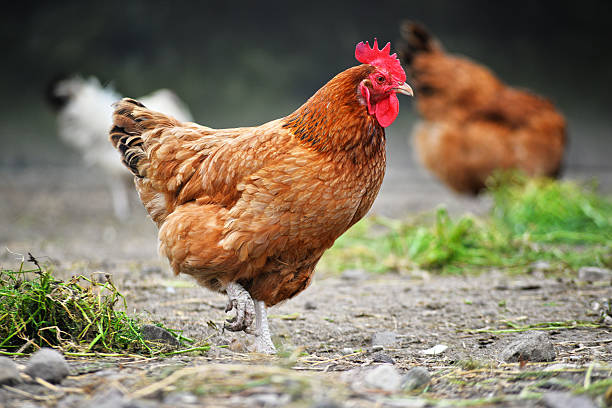
How do we know that our chickens are kosher?
BY: RABBI MOSHE BILLER
The Torah¹ identifies twenty-four different species of non-kosher birds. All other birds not listed in the Torah are considered kosher and may be consumed. However, consumption is permitted only if we are absolutely sure that that the species in question is not one of the twenty-four. While the Torah lists the names of the non-kosher birds, their identity is not entirely clear to the layman.² The Gemara³ and the Shulchan Aruch⁴ describe three simonim – characteristics – that are common in all of the non-kosher birds so that they can be properly identified by a layman:
- Dores v’Ochel – non-kosher birds kill their prey prior to consuming them;
- Cholek es Raglav b’Chut – if the bird is placed on a string it would balance itself by splitting its fingers and placing two fingers on the string facing forwards and two fingers on the string facing backwards;
- Kolet min Ha’avir v’Ochel – the bird is able to catch food thrown at it and consume it while not putting it down.
The Shulchan Aruch continues to list three simonim that would identify the bird as kosher:
- Etzba Yesira – the bird has an extra toe in the back of the foot which is not in line with the other fingers;
- Zefek – the bird has a crop;
- Kurkuvan niklaf b’yad – the skin of its gizzard can be peeled by hand without a knife.
Nevertheless, the Shulchan Aruch concludes that even when a bird has all the simonim of a kosher bird, we are still not permitted to consume it unless we have a mesorah, a tradition for generations, that the bird in question is kosher. The Shulchan Aruch⁵ states that if a bird bears the three aforementioned simonim plus an additional two simonim then it is kosher; a) its beak is wide; and b) the palm of its foot is wide like a goose. The Rema disagrees and says that simonim are never sufficient and consumption cannot be allowed without a proper mesorah.
Chickens are the most common birds that are raised for human consumption. Jewish people have been eating chicken meat and eggs throughout our history.⁶ However, in modern times, there are hundreds of different breeds of chickens. Some breeds bear minor differences, while others are vastly different from one another. Until the early part of the twentieth century, all breeds were raised for both their eggs and meat. While the Gemara⁷ implies that some chickens were designated for eggs and others designated for meat, it is abundantly clear that it refers to the same breed of chickens, which were raised for both purposes.⁸ Over time the many breeds were categorized as either layers or broilers; layers were identified as being suitable for their eggs while broilers were more suitable for meat. As an example, Europeans identified the Italian White Leghorn as a layer.
Today, the White Leghorn is commonly raised as a layer used for its white eggs. The mesorah for the white leghorn goes back hundreds of years and, fascinatingly enough, pictures of chickens from historical settings dating back a few thousand years appear almost identical to the white leghorn today.
Approximately twenty years ago, a question to the authenticity of the mesorah of the Leghorn arose. The new question was based on the observation that when a Leghorn was placed on a string, it was cholek es raglav b’chut, it split its fingers by placing two fingers on the string facing forwards and two fingers on the string facing backwards, which is the simon of a non-kosher bird. Perhaps the mesorah should be challenged based on this problematic simon? It is not plausible to think that it may have been crossbred with a non-kosher bird since the Leghorn today appears identical to the Leghorn that has been consumed throughout history.
But what about the fact that the simon seems to indicate that it is non-kosher? Rabbi Meir Brandsdorfer zt”l in his responsa Knei Bosem⁹ attests to the kashrus of the Leghorn and explains that during testing that was conducted by experts, although the chickens immediately were cholek es raglayhem b’chut, they did so uncomfortably and eventually changed their position and placed three fingers in front of them while placing only a single finger behind them which is similar to the way a kosher bird would stand on the string.
Other experts answered the question by explaining that the only birds that split their fingers in the problematic way were domesticated and farmed together with ten to thirty thousand chickens in the same barn as opposed to the free-range chickens. It appears that since they were not raised naturally, their legs did not develop the strength that would be necessary to balance on a string without splitting their fingers. When the free-range chickens and newborn chicks were tested they always placed three fingers in front of them with only one behind them. It was concluded that the leghorn chicken has a strong mesorah and is certainly kosher.
Chickens that are raised for their meat are called broilers. The most commonly used breed of broiler is called the Cornish X Rock which is bred by two different companies, Cobb and Ross. Most broilers in Canada and the United States are bred by Cobb whereas the broilers in Eretz Yisroel are bred by Ross. When breeding takes place the most common male that is used is a White Cornish for it its beautiful white color. The female chicken that is used for breeding is a cross between a Cornish Rock, Rhode Island Red, New Hampshire Red and Cornish Leghorn. Each breed which is used has a mesorah as they have been serving as the breeds that were shechted throughout the last few hundred years.
This leaves us to question whether crossbreeding has historically occurred without our knowledge. Perhaps a breed, which bears no mesorah, was introduced into the mix? The following Poskim discuss this phenomenon and conclude that this is not a halachic concern for several reasons:
Maharam Schick¹⁰ writes that if we do not observe any difference in the bird we do not have to suspect that a new breed was introduced as the bird maintains its chezkas heter. Today’s chickens appear identical to the ones that were always shechted.
Darkei Teshuva brings in the name of the Arugas HaBosem¹¹ that an overwhelming statistical observation can be sufficient to create a new mesorah. We have collectively been shechting millions of chickens annually for sixty years and have never observed a kosher chicken that was dores v’ochel.
The Netziv in Meishiv Davar¹² writes that even if the chickens would look different than the ones that were shechted historically it would still not be a problem. The fact that we have been eating them without concern for the span of many years without any reason to suspect a problem creates a minhag which can act as a mesorah. This coupled with the fact that these birds contain all three simonim of a kosher bird cited above reassure us that they are indeed kosher and bear a proper mesorah.
The Divrei Chaim¹³ further explains that our resistance to consuming birds with proper simonim but without a mesorah is itself a minhag from the Rema, as explained above. In a situation where a doubt is raised concerning the mesorah, we can be lenient.
Rabbi Moshe Biller is the Rav Hamachshir for COR’s Shechita Division
Footnotes
- Devarim (14, 11)
- See https://en.wikipedia.org/wiki/Kosher_animals under the section called “Birds” for the translation of many of the types of non-kosher birds listed in the Torah
- Chulin (63)
- Yoreh Deah (82, 1-3)
- Ibid. Sif 3
- See, for example, the first Mishna of Beitza and the Gemara in Chulin and Gittin
- Beitza (2)
- Ibid. (4)
- Volume 4, Simon 46
- Simon 100
- Yoreh Deah (16)
Kashruth Council of Canada | www.cor.ca — 2022 / 5783, Halachic Corner, pp. 10–11
COR, the Kashruth Council of Canada, is one of the world’s largest kosher certification agencies, certifying thousands of products, restaurants, and facilities. Learn more at cor.ca, or read about our certification services at corkosher.com.